

A Pastel Sec painting by Stephen Lack Alright, so this is what is called a Pastel Sec, a Dry… Just imagine a thick crayon, a really thick crayon, it’s pastel with oils in it and it actually works like that. The advantage, is that you actually see texturing in...
Read More
A Carborundum etching by Pierre Marie Brisson Alright, so this is another piece by Pierre Marie Brisson from France and you can see the stick figures. As somebody said, chicken scratching by a doctor or by me, because my handwriting is a little bit like that by now. What...
A Custom Frame So, this particular piece is a drawing of a house that was built in 1900. The client brought it in, it’s an ink and coloured image, brought it in for us to frame. The client wanted to create a situation where he was using some of...
A giclée print Alright so this is an artist who actually paints on carpets and that’s why you’re getting that kind of an image on here. I can’t tell you where it was done but this is, so this is a giclée. A giclée is a scanned image of...
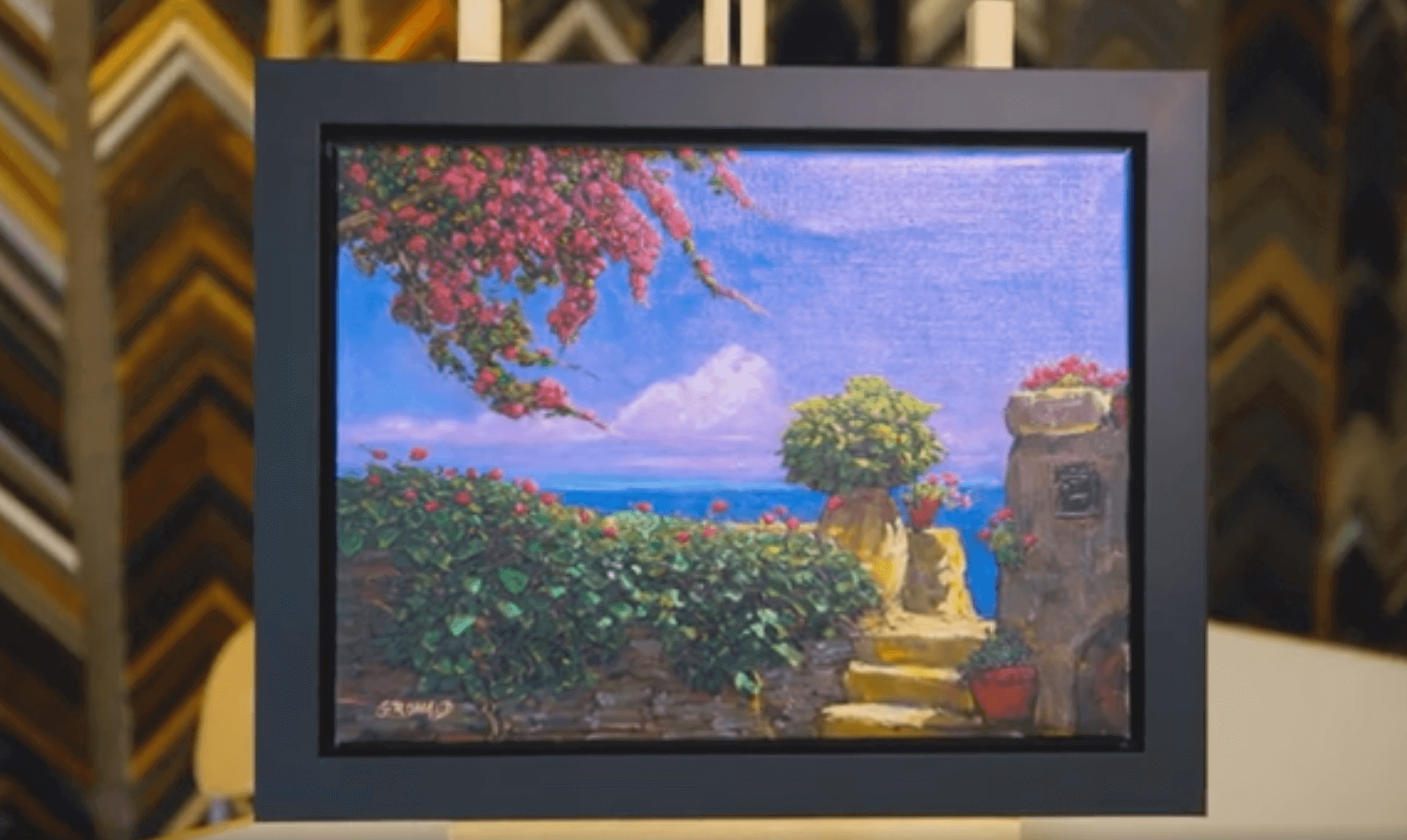
In the world of framing, there are two main ways to do it: adding a conventional frame or adding a floating frame (also called an American box frame). The latter is particularly well suited to contemporary, Scandinavian, industrial, minimalist and modern decors. Simple and chic, it will enhance the...

The purpose of a frame is to focus your eye. To focus the eye of the viewer, so that your peripheral vision isn't distracting, doesn't distract you from the content

Your eye should fall on the middle of the top third of the artwork if you are looking straight ahead at it.Of course, we are different degrees of tall so that space will change depending on how tall you and yours are. Mostly, though, you don’t want to have...

You might as well ask why we get dressed. Framing dresses up your artwork and it helps set it off from your wall. When you simply hang a painting up unframed, you, obviously, get to see the painting on your wall. The lines defining your painting, unframed, on your...

Paper is made from fibers that stick together because of the starch inherent in the fibers. Dust can easily imbed itself in between those fibers. When that happens, the starch breaks down and the paper eventually breaks apart. Glass acts as a dust barrier protecting the surface of the...